Change Language :
igus Robot Control Software: Free Robot Programming Software Download
Program, simulate and control robots licence-free
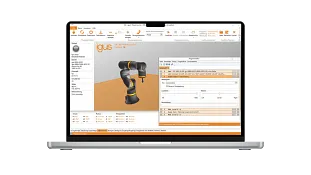
The igus Robot Control makes it easy and intuitive to program, simulate and control robots. Its modular design supports a range of robot kinematics, including delta robots, gantry robots and multi-axis articulated robots. Individual robot movements and motion sequences can be tested in an integrated 3D simulation without connecting a physical robot. The robot programming software is available to download free of charge, with no licence fees or time limits.
What you will find on this page
Free robot software
Programming examples of various applications with the robot software
- Simple connection between robot and control system
- Intuitive operation with 3D interface and digital twin enables direct execution and checking of motion sequences
- Camera interface configuration possible directly via control system and software
- Programming of delta, linear, SCARA and articulated arm robots
- Software enables risk-free testing even before purchase
System requirements:
- PC with Windows 10 operating system
- Communication via Ethernet or WLAN
- 500MB of free disk space
Sample programs, wiki and training courses
Interfaces
PLC interfaces
The PLC interface (PLC = Programmable Logic Controller) enables the execution of basic functions and the signalling of states by means of digital inputs and outputs. In addition to the control by a PLC, this interface also enables operation via hardware buttons.
Digital inputs and outputs
Robot programs can be loaded and started and gripper commands can be sent via digital inputs or global signals. This is useful, for example, if a program is to be selected from a given selection using buttons or the CRI-GSig instruction.
Modbus TCP/IP
The Modbus TCP interface can be used to send PLC data and instructions to the robot control system and receive status information, for example.
CRI interface
The CRI interface enables complex instructions to be sent and information and settings to be retrieved via the Ethernet interface using TCP/IP. The igus Robot Control uses this interface to connect to robots with an integrated control system or other instances of the control system.
Camera interface
The camera interface enables the use of object detection and video cameras. Object detection cameras recognise the position and class of objects and transmit these, optionally with a video image, to the control system. The control system calculates positions in the robot coordinate system from the object positions of the camera. Pure video cameras only deliver images and can therefore only be used to monitor the work area, but not to detect objects.
Cloud
The Cloud interface enables the robot to be monitored via RobotDimension. Once activated and logged in, the robot sends basic status information and camera images to the online service. The user can list their robots on the website and retrieve the information.
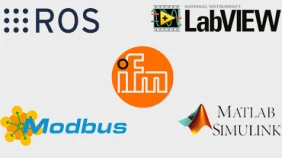
ROS, Matlab, LabView, and many more.
Integrate the robots into your ROS environment. Documentation and packages for hardware communication, Teleop and moveI
Project configurations
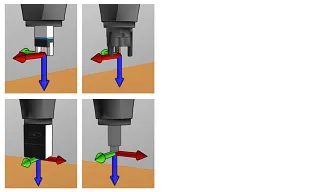
Gripper
The assembled tool can be specified here. Changing the tool requires the project to be reloaded or the integrated control system to be restarted. New tools can be defined as a configuration file in the directory "Data/Tools"
Virtual box
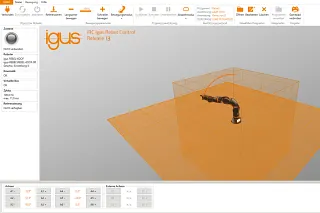
The range of movement of the robot arm is restricted by the settings of the virtual box. This functionality helps to prevent mechanical damage and simplifies programming, depending on the application. If a program is executed that violates the virtual box, it is stopped with an error message.
External axis
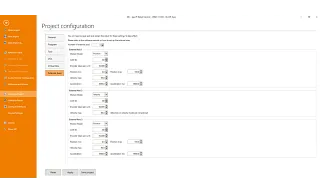
The robot control system supports up to 3 additional axes (also called "external axis" in iRC). These can be installed according to the robot axes and configured via the configuration area of iRC.
Program
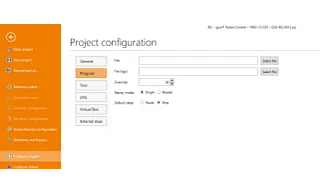
Here you can define the robot and logic program, the movement speed (as a percentage of the maximum speed), the playback mode and the reaction to program errors.
Special kinematics
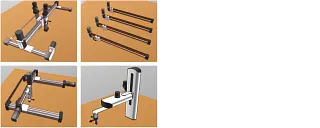
The robot control system can be customised for your robot with a digital twin. We configure the inverse kinematics to suit your project business.
Programming
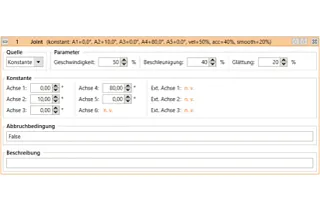
Axis movements
The Joint command moves the robot to an absolute target position that is specified in axis coordinates (e.g. axis angle or position of a linear axis). The resulting movement of the TCP is usually a curve and not a straight line.
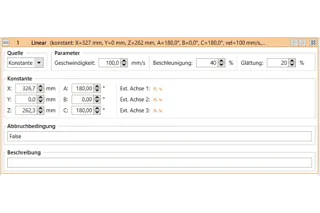
Linear movement
The Linear command moves the robot to an absolute target position specified in Cartesian coordinates. The resulting movement of the TCP follows a straight line.
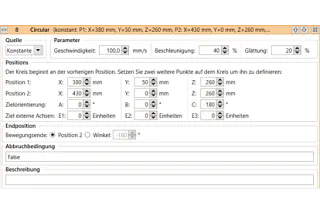
Circular movements
The instruction "Circular movement" enables movements along a full or partial circular path. It is compatible with linear movements so that the transition from and to linear movements can be smoothed over.
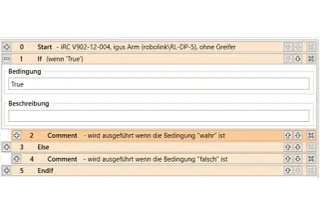
Conditions
Conditions can be used in if-then-else commands, loops and as cancellation conditions in motion commands. The conditions can be combinations of digital inputs, global signals, Boolean operations and comparisons.
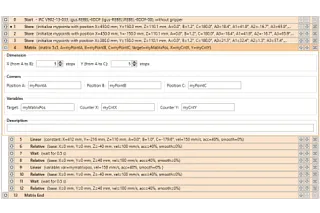
Matrix calculation
The grid instructions calculate positions aligned to a grid, e.g. as a gripping or depositing position for palletising tasks.
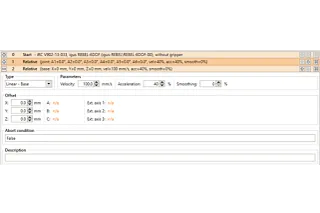
Relative
The Relative command allows you to move the robot relative to its current position. It can be accessed via the menu items under "Action" → "Relative movement".
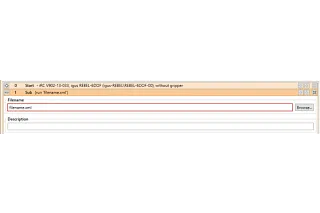
Sub-programs
Sub-programs can be called up with the sub-command. The path to the sub-program file is specified under "File name". It is relative to the subfolder "Programs" of the iRC folder "Data".
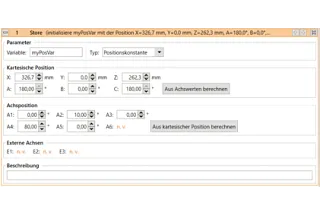
Variables and variable access
Two types of variables are supported in the program for igus Robot Control and TinyCtrl:
- Number variables: These can be used to store integer or floating point numbers.
- Position variables: These can be used to store Cartesian positions and joint positions. Whether such a variable is interpreted as a Cartesian position or joint position depends on the context.
Download robot software
The licence-free igus Robot Control software is integrated into the control system and therefore uses a standardised operating concept and consistent communication services for many components of one system. This means less project planning work and faster commissioning.
- Test all igus kinematics in advance in the software
- With pre-programmed projects for all igus robots, single axes and AGVs
- Intuitive 3D interface with simulation of the robot
What is robot programming software?
Robot programming software is an application used to program, simulate and control physical robots. Users can define motion sequences, move robots to specific positions, create robot programs and configure communication between the robot, controller and connected components. Common terms for this type of application include “robot control software”, “robot programming software” and “robotics software”. It is important to distinguish robot programming software from software robots. A software robot usually refers to an RPA bot that automates repetitive digital business processes in systems such as SAP, ERP or Microsoft Office. igus Robot Control is not an RPA solution. It is software designed for physical robot hardware and industrial automation applications
What makes igus Robot Control different?
Many robot programming solutions are either time-limited trial versions that require payment after the trial period or proprietary applications that only work with robots from a single manufacturer. igus Robot Control is permanently free to use, with no licence fees or time limits. The software supports multiple robot kinematics and can be integrated into existing automation environments through open interfaces for ROS, MATLAB and LabVIEW. Users also benefit from free sample programs, comprehensive wiki documentation and practical robot programming training for beginners and advanced users.
Program and simulate robots for free without hardware
The integrated 3D robot simulation environment allows you to plan and test motion sequences before connecting a physical robot. A digital twin provides a virtual representation of the selected robot kinematics. This offline robot programming functionality helps identify errors at an early stage and reduces commissioning time. Once the robot program has been tested in the simulation, it can be transferred directly to the physical robot hardware.
Features of the igus Robot Control software
• Programming for delta, gantry, SCARA and articulated robots
• Intuitive 3D interface with a digital twin for robot simulation
• Linear, circular and axis-specific motion commands
• Conditions, loops and subroutines for complex automation sequences
• Virtual workspace limits and position variables
• Configuration of grippers and up to three external axes
• Camera and PLC interfaces for object detection and automation
• Communication via digital inputs and outputs, Modbus TCP/IP and CRI
• Integration with ROS, MATLAB and LabVIEW
System requirements
To get started, you only need a computer running Windows 10 with approximately 500 MB of available storage space. An Ethernet or Wi-Fi connection is required to communicate with the robot.
Project configuration and robot programming commands
For each project, users can configure grippers, virtual workspace limits, up to three external axes, individual error-handling settings and playback modes. The inverse kinematics can also be adapted for custom robot configurations. Available programming functions include axis movements in joint coordinates as well as linear and circular movements in Cartesian coordinates. Conditions, loops, subroutines and matrix calculations can be used to create complex programs and palletising applications. Relative movements based on the robot’s current position, numerical variables and position variables complete the range of programming functions.
Interfaces for robot control and industrial automation
igus Robot Control provides several interfaces for controlling robots during operation. These include PLC connectivity via digital inputs and outputs or Modbus TCP/IP, the CRI interface for sending complex commands over Ethernet, and a camera interface for object detection. The robot can also be monitored remotely using the RobotDimension cloud. These connectivity options allow the software to integrate directly into existing robot control and industrial automation environments rather than operating as an isolated system.
Sample programs, wiki documentation and training
Pre-programmed sample projects for igus robots, individual axes and automated guided vehicles make it easier to get started. Comprehensive wiki documentation provides answers to detailed technical questions. Practical training courses for beginners and advanced users teach robot programming in either individual or group sessions.
Download free robot programming software
igus Robot Control is available as a free download, with no licence fees, hidden costs or charges after a trial period. You do not need a connected robot to get started. Simply select the required robot kinematics, create a project and test your motion sequences in the integrated 3D robot simulation. Download igus Robot Control today and start programming, simulating and controlling robots for free
Consulting
I look forward to answering your questions
J. & E. Papadopoulos S.A.+30 210 4113133Write e-mail
Shipping and consultation
In person:
Monday to Friday from 7 am - 17 pm.
Saturdays from 8 am- 12 pm.
Online:
24h
WhatsApp-Service:
Montag – Freitag: 8 – 16 Uhr